
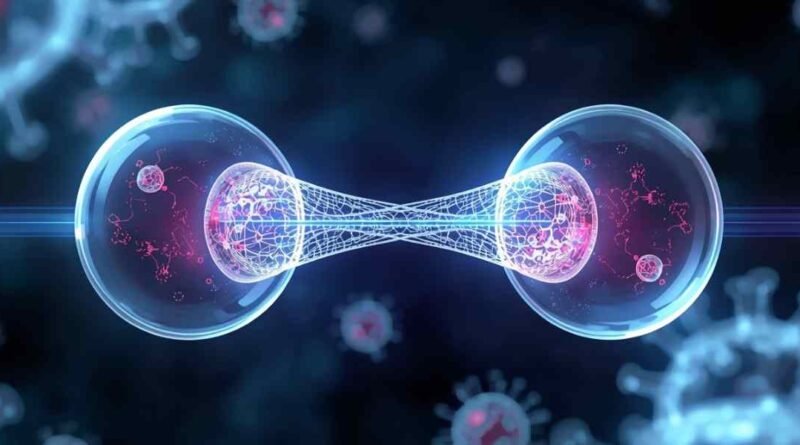
Light-Controlled Synthetic Communication Networks via Paired Connexon Nanopores
Light-Controlled Synthetic Communication Networks via Paired Connexon Nanopores represent a new direction in how scientists design communication between biological and artificial systems. Instead of relying only on chemical signals or electrical impulses, researchers are now exploring ways to use light as a precise control signal for molecular communication.
In traditional biology, cells exchange information through chemicals or ion channels. These methods work well, but they are limited in speed, precision, and external control. That is why scientists are now moving toward engineered systems where communication can be switched on and off externally, especially using light.
Light is extremely useful in this context because it can be controlled with high accuracy in terms of timing, intensity, and location. This makes it ideal for regulating microscopic systems without physically touching them.
What Are Light-Controlled Synthetic Communication Networks?
Light-Controlled Synthetic Communication Networks via Paired Connexon Nanopores are engineered molecular systems designed to control communication between two separate biological or synthetic compartments using light as an external trigger.
These systems work by allowing molecules to pass through nano-sized channels only when activated by specific wavelengths of light. This creates a programmable communication system at the molecular level.
Unlike natural biological communication, which is often automatic and chemically driven, these networks are externally controlled. This makes them highly flexible and programmable.
These systems sit at the intersection of synthetic biology, nanotechnology, and photonics. Researchers are essentially building “light-operated biological circuits” that can control how molecules move and interact.
The key idea is simple:
Light acts as a switch, and nanopores act as communication gates.
Biological Inspiration: Connexons and Gap Junctions
To understand these systems, it helps to look at how nature already solves communication problems.
Connexons are protein structures found in living cells. They form gap junctions, which are direct channels between two cells. These channels allow ions and small molecules to move freely, enabling fast communication.
In natural systems, gap junctions are essential for processes like:
- Heart muscle coordination
- Neural signaling
- Tissue synchronization
Scientists took inspiration from this natural system. Instead of using only biological control, they designed synthetic versions that can be externally regulated.
This shift from natural to engineered systems allows researchers to add a new layer of control that does not exist in biology: light-based switching.
Structure of Paired Connexon Nanopores
The term “paired connexon nanopores” refers to two aligned nanochannels that form a complete communication bridge between two compartments.
Each nanopore is embedded in a membrane, and both must align properly for molecular transfer to occur.
These structures typically include:
- Two engineered nanopores acting as a matched pair
- A membrane system separating two environments
- A precise alignment mechanism ensuring connectivity
In synthetic systems, materials used can vary widely. Researchers often use:
- Engineered proteins
- Polymer-based membranes
- Hybrid bio-nanomaterials
The key requirement is stability and responsiveness to external signals, especially light.
This paired structure ensures that communication only happens when both sides are correctly aligned and activated.
How Light-Control Mechanism Works
The core innovation in Light-Controlled Synthetic Communication Networks via Paired Connexon Nanopores is the ability to control molecular movement using light.
This is achieved using photoresponsive molecules. These molecules change their shape or structure when exposed to light.
When light is applied:
- The nanopore structure changes shape
- The channel opens or closes
- Molecular flow is either enabled or blocked
This creates a reversible ON/OFF switch controlled by light.
Different wavelengths can be used for different effects:
- UV light: Often triggers structural opening or activation
- Visible light: Used for reversible switching in many systems
- Near-infrared light: Useful for deeper biological penetration
The advantage of light is that it allows precise control over both time and space. Researchers can activate only specific regions without affecting surrounding systems.
Molecular Transport Mechanism Inside Nanopores
Inside these nanopores, molecular transport happens at a very small scale, often involving ions, small proteins, or signaling molecules.
The process relies on diffusion, but it is tightly regulated by the pore structure.
Key mechanisms include:
Ion and molecule diffusion
Molecules move from high concentration to low concentration through the nanopore when it is open.
Selectivity and size filtering
Nanopores are designed to allow only certain molecules to pass based on size and charge.
Gating kinetics
This refers to how fast the pore opens or closes in response to light.
Energy efficiency
Unlike active transport systems in biology, many synthetic nanopores rely on passive movement, making them energy-efficient.
Key Components of the System
1. Synthetic Nanopores
These are the core channels that allow molecular transfer. They are engineered for precision, stability, and responsiveness.
Material engineering approaches include protein design and polymer nanofabrication.
2. Photoresponsive Switches
These are molecules that respond to light. They act like molecular switches that control nanopore behavior.
3. Membrane Framework
The nanopores are embedded in membranes such as lipid bilayers or synthetic polymer films. These membranes separate two environments.
4. Signaling Molecules
These are the molecules that carry information. They can include ions, peptides, or synthetic chemical signals.
Natural vs Synthetic Communication Systems
| Feature | Natural Cell Communication | Light-Controlled Synthetic Networks |
|---|---|---|
| Control Method | Chemical and electrical signals | Light-based external control |
| Precision | Moderate | Extremely high |
| Reversibility | Limited | Fully reversible |
| Programmability | Low | High and customizable |
| Speed of Response | Biological speed | Near-instant light-triggered response |
| Scalability | Naturally limited | Engineerable and expandable |
Applications in Modern Science
Synthetic Biology
These systems allow scientists to design artificial cells that communicate like living tissues. They can:
- Coordinate behavior between artificial cells
- Build programmable biological circuits
- Simulate tissue-like structures
Drug Delivery Systems
One of the most promising uses is controlled drug release.
A drug can be sealed inside a nanoparticle and only released when exposed to light. This allows:
- Targeted therapy
- Reduced side effects
- Precise timing of drug activation
Bioelectronics
These systems can bridge biology and electronics. They enable:
- Biological sensors that respond to light
- Hybrid devices combining living cells and circuits
- Implantable responsive systems
Future Smart Systems
In advanced research, these networks could support:
- Biological computing systems
- Self-regulating cell networks
- Adaptive medical systems
Advantages of Light-Controlled Nanopore Networks
These systems offer several important benefits:
- High spatial precision in activation
- Non-invasive external control
- Fully reversible switching behavior
- Ability to scale into complex networks
- Low interference between channels
Technical Challenges and Limitations
Despite their promise, several challenges remain:
- Limited light penetration in deep tissues
- Stability issues in long-term biological environments
- High complexity in nanopore engineering
- Expensive nanoscale fabrication techniques
- Difficult integration with living organisms
These limitations are active areas of research in synthetic biology and nanotechnology.
Recent Research Developments
Recent advancements in this field include:
- Optogenetic-inspired nanopore designs
- Multi-wavelength control systems for layered activation
- Hybrid experiments combining living cells and synthetic channels
- AI-based modeling for nanopore design optimization
- Early laboratory demonstrations of controlled molecular networks
These developments show that the field is moving from theory toward practical applications.
Future of Synthetic Communication Networks
The future of Light-Controlled Synthetic Communication Networks via Paired Connexon Nanopores is highly promising.
Potential developments include:
- Large-scale artificial tissue communication systems
- AI-integrated cellular control systems
- Smart therapeutic platforms for personalized medicine
- Molecular-scale computing systems
- Self-regulating biomedical devices
As control techniques improve, these systems may become central to next-generation biotechnology.
Practical Working Example
To understand how the system works, consider a simple example:
Two artificial cells are connected using paired nanopores.
Step 1: The system is inactive, and the channels are closed.
Step 2: Light is applied to the system.
Step 3: The nanopores open due to structural change.
Step 4: Signaling molecules move from one cell to another.
Step 5: The receiving cell responds by activating a biological function.
Step 6: Light is removed, and the system resets.
This simple cycle demonstrates how communication can be precisely controlled using light.
Why This Technology Matters
This technology represents a shift toward programmable biology. Instead of relying only on natural processes, scientists can now design systems that behave like programmable machines at the molecular level.
It has major implications for:
- Medicine and targeted therapies
- Nanotechnology and material science
- Bioengineering and synthetic tissues
- Future healthcare systems
It is part of a broader movement toward controllable and intelligent biological systems.
FAQ Section
What are light-controlled nanopores used for?
Light-controlled nanopores are mainly used to regulate molecular transport at the microscopic level. They are widely studied in synthetic biology and drug delivery systems.
These structures allow scientists to control when and how molecules pass between compartments. This makes them useful for precise biological engineering.
How do paired connexon nanopores communicate?
Paired connexon nanopores communicate by forming a connected channel between two compartments. Both nanopores must align correctly for molecular transfer to occur.
When activated by light, the channel opens and allows selective molecules to pass through. This ensures controlled and directional communication.
Is this technology already used in medicine?
Currently, this technology is mostly in research and experimental stages. It has not yet been widely applied in clinical medicine.
However, early studies in drug delivery and biosensing show strong potential for future medical applications.
What makes light control more effective than chemical control?
Light control offers higher precision because it can be applied instantly and locally. Chemical signals are slower and harder to control externally.
Light also allows reversible switching without introducing additional substances into the system.
Can these systems work inside the human body?
In theory, yes, but there are challenges. Light penetration in deep tissues is limited, which makes internal control difficult.
Researchers are exploring near-infrared light and fiber-based systems to overcome this limitation.
What materials are used to build synthetic nanopores?
Synthetic nanopores can be made from engineered proteins, polymers, or hybrid biomaterials.
The choice of material depends on stability, responsiveness, and compatibility with biological systems.
How close is this technology to real-world applications?
The technology is still in early development stages. Some lab-scale systems have been successfully demonstrated.
However, real-world medical and industrial applications will require more time for stability and scalability improvements.
What are the biggest challenges in scaling these systems?
Scaling these systems is difficult due to design complexity, cost of fabrication, and maintaining stability in large networks.
Another challenge is ensuring consistent performance across multiple nanopores in dynamic environments.
Conclusion
Light-Controlled Synthetic Communication Networks via Paired Connexon Nanopores represent a major step forward in how scientists think about communication at the molecular level.
By combining biology, nanotechnology, and light-based control, researchers are building systems that can be programmed with high precision.
While challenges still exist, the progress so far shows strong potential for future applications in medicine, synthetic biology, and smart bioengineering systems.
As research continues, these systems may become a foundation for next-generation programmable biological technologies.